

























• Core software platform

      Secure boot management

      Configuration and development tools

      About Us

      AVIN Systems is the home for automotive embedded software products and services specializing in AUTOSAR, E-E architecture, SDV, Advanced Driver Assistance System (ADAS), Electric Vehicle and Cloud Technologies.

    • Driving growth through trusted expertise

      Visionary leaders guiding our journey

      Recognized standards of quality excellence

      Connected with leading industry network

      Strong alliances delivering greater value

      Insights shaping industry conversations

      Events that create lasting connections

      Proven results from real‑world success

      About Us

      AVIN Systems is the home for automotive embedded software products and services specializing in AUTOSAR, E-E architecture, SDV, Advanced Driver Assistance System (ADAS), Electric Vehicle and Cloud Technologies.

  • Careers
  • Contact Us
Hardware Abstraction and OS Abstraction

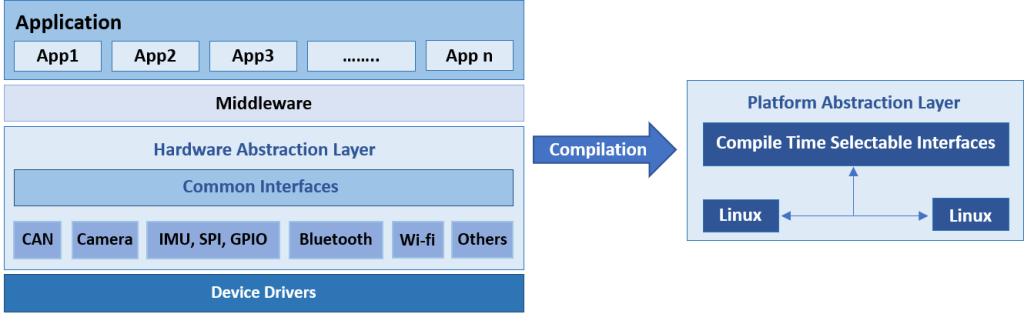
AVIN Systems delivers hardware and OS abstraction solutions that enhance software portability and modularity for SDV platforms. Our services include driver abstraction, type system development, CI/CD integration, and automated testing for scalable automotive software architectures.

Service Highlights

End‑to‑End Abstraction Layer Development
Robust HW/OS abstraction frameworks that enhance portability, scalability, and modularity across SDV environments.
Cross‑Platform OS Support
Expertise in building unified abstraction layers for both Linux and QNX, ensuring consistent behavior across mixed‑OS automotive architectures.
Comprehensive Peripheral Driver Abstraction
Unified API layers for cameras, LiDARs, Radars and other sensors, communication buses, GPIOs, and other peripherals—enabling rapid integration and platform independence.
Advanced Type System Engineering
Dynamic type‑based solutions that support flexible application loading, runtime decision‑making, and feature modularization.
Agile, CI/CD & Automation‑Driven Development
Modern engineering workflows with automated testing and CI/CD pipelines to minimize errors and accelerate delivery.
Optimized for Software‑Defined Vehicles (SDVs)
Architectures designed to support continuous updates, hardware evolution, and long‑term maintainability for next‑gen automotive platforms.

Service offerings

Development of Hardware & OS Abstraction Modules

We design and implement modular abstraction layers to simplify hardware access and OS level interactions.

Our services include:

  • Development of C++ and Python–based abstraction modules that provide stable, well-defined interfaces for upper-layer applications.
  • Creation of OS independent and hardware-independent APIs, allowing application teams to focus purely on feature development.
  • Architectural design that supports loose coupling, modularity, and long-term maintainability.


Abstraction Layer Implementation for Linux & QNX

AVIN Systems provides deep expertise in creating portable abstraction layers across leading automotive operating systems.

  • Implementation of abstraction services tailored for Linux (Yocto based, Ubuntu based, custom distros).
  • Development of QNX specific abstraction components leveraging POSIX APIs, resource managers, and microkernel services.
  • Unified abstraction framework enabling runtime portability between Linux based HPCs and QNX based safety systems.


Device Driver Abstraction for Automotive Peripherals

We provide middleware abstractions for a wide range of automotive peripherals and I/O devices:

  • Camera and Imaging Device abstraction
  • Sensor abstraction for LiDARs, Radars and other sensors.
  • Communication Bus abstraction including CAN, LIN, SPI, I2C, and Ethernet based automotive networks.
  • GPIO and low level peripheral abstraction, ensuring consistent application behavior across different SoCs and hardware variants.
  • Standardized APIs that support rapid onboarding of new devices, SoCs, and platforms.

AVIN Systems uses modern tools and languages to build scalable, portable, and modular abstraction layers for automotive platforms.

Languages & Frameworks:

  • C++
  • Python

Operating Systems:

  • Linux
  • QNX

Development & Automation Tools:

  • CI/CD pipelines
  • CMake
  • Conan Build System
  • Test Automation Frameworks

Download Service Flyer

Explore features and specifications in our service flyer.

Our Experience

Our team brings deep technical expertise and a commitment to quality in every project.

Development of hardware abstraction layers to standardize I/O access
Elimination of hardware and OS dependencies for application portability
Expertise in driver modularity and device independence
Support for clean architecture and reusable components
Proven delivery using Agile practices and modern build systems

Tool Chain

AVIN Systems uses modern tools and languages to build scalable, portable, and modular abstraction layers for automotive platforms.

Hardware Abstraction and OS Abstraction

Case Studies

Frequently Asked questions

Hardware abstraction creates a unified software interface that hides SoC‑specific or board-specific details. This improves portability, modularity, and long-term maintainability, which are essential for Software‑Defined Vehicles (SDVs) where hardware evolves but software must remain compatible.

AVIN Systems develops OS‑independent APIs and modular abstraction layers that enable software to run consistently across Linux, QNX or VxWorks reducing rework and improving scalability.

Yes. We specialize in building unified abstraction layers compatible with both Linux (Yocto, Ubuntu, custom distros) and QNX (POSIX APIs, microkernel services) to ensure runtime portability across diverse ECUs and HPCs.

We provide services to develop abstraction for:

  • Cameras & Imaging devices
  • LiDAR, Radar, and other sensors
  • Communication buses (CAN, LIN, SPI, I2C, Ethernet)
  • GPIO and low-level peripherals

Absolutely. We provide services and support to design hardware and OS‑agnostic APIs that eliminate SoC dependencies, enabling applications to run seamlessly across various popular and custom SoCs.

Our abstraction modules are primarily built using:

  • C++ (high‑performance, strongly typed, automotive‑grade)
  • Python (automation, tooling, testing, integration workflow

We integrate CI/CD pipelines, automated testing frameworks, CMake, Conan, and modern DevOps workflows to ensure accelerated delivery, reduced regression risk, and continuous software reliability.

Yes. By eliminating hardware‑specific and OS‑specific dependencies, abstraction layers allow applications to be reused across multiple platforms—boosting portability, scalability, and faster SDV deployment.

Yes. We create middleware abstraction modules for cameras, LiDARs, Radars, communication buses, and low‑level hardware. This standardization enables plug‑and‑play device onboarding without needing application changes.

Yes. We engineer advanced type systems that enable runtime decision‑making, dynamic feature loading, and modular software deployment, which are critical for SDV architectures.

Key benefits include:

  • Faster integration of new hardware
  • Reduced software maintenance costs
  • Cleaner architecture with reusable components
  • Platform independence and future‑proofing
  • Improved testability and reliability

We use clean architecture principles, reusable components, strong type systems, and continuous testing within automated pipelines. This ensures the abstraction layer remains robust, scalable, and maintainable over the entire vehicle lifecycle.

Enable next-gen SDV platforms with AVIN

Partner with AVIN to advance Software‑Defined Vehicles through intelligent architectures and trusted engineering expertise.